


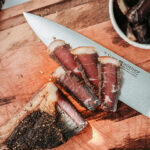
You may ask, why bother making biltong when you can simply buy it at most shopping centres? After all, it’s one of South Africa’s most beloved snacks.
But here’s why crafting your own quality biltong is so worth it:
1. Substantial savings – especially if you source your meat through a food club or directly from regenerative farms.
2. Healthier snack – turn what is often a processed, toxic treat into a nourishing superfood.
The Cost Factor
At the time of writing, decent ready-made biltong costs R500–R680 per kilogram. Making your own with raw biltong steaks lowers your cost dramatically while giving you complete control over quality and ingredients.
Check out the grass-fed biltong steaks from our Witbank Food Club Supplier – Langside Meats
(Request with or without seasoning | With or without fat)
If you love biltong (like most of us do), you’ll want every bite to support – not strain – your health.
Choosing the Right Meat – Grass-Fed (and Grass-Finished) vs Grain-Fed
Grass-fed beef has a far superior nutritional profile – leaner, richer in omega-3s, antioxidants, CLA, and fat-soluble vitamins like A and E
The omega-6 to omega-3 ratio is much healthier – often 1:1 to 3:1 versus 5:1 to 7:1 in grain-fed animals – helping reduce inflammation..
Grass-fed beef also contains fewer harmful saturated fatty acids (C12–C16) and fewer total saturated fats while offering more anti-inflammatory PUFAs and minerals.
Grain-fed cattle often consume pesticide-contaminated or GMO grain, antibiotics, and growth hormones- raising serious concerns about endocrine & microbiome disruption and other toxins in the meat.
Additionally, feedlot-fed cattle are at higher risk of harboring digestive pathogens and antibiotic-resistant bacteria because their diets alter gut acidity and immunity
In short: grass-fed biltong tastes cleaner, nourishes better, and supports health long-term.
The Seasoning: Why Quality Matters
The Problem with Cheap Seasoning Ingredients
Budget producers often rely on ultra-processed ingredients – cheap salts, vinegars with preservatives, flavour enhancers, free-flow agents, and other additives. Many are classified as “generally recognized as safe” (GRAS), but that doesn’t eliminate long-term health risks.
A German study over 11 years found that certain additives – like flavour enhancers (e.g., MSG, ribonucleotides), artificial sweeteners (acesulfame, sucralose), and processing aids – were linked to significantly increased mortality
Another report highlighted additives such as BHA, propyl paraben, polysorbates, and carboxymethyl cellulose, all tied to potential cancer, gut inflammation, endocrine disruption, and cardiovascular issues
More broadly, chemicals like BHA, BHT, artificial colours (e.g., Red Dye No. 3), titanium dioxide, and preservatives often allowed without rigorous testing are under scrutiny for endocrine, neurological, and carcinogenic effects
A systematic review confirms that common food additives – from nitrates to coloring agents – increase risk of immune, digestive, and long-term chronic conditions
Why Your Seasoning Should Be Clean
Salt: Use mineral rich quality rock salt – Himalayan or, better yet, Oryx Desert Salt from South Africa.
Avoid dyed or adulterated salts. Excessive cheap table salt intake is linked to hypertension, heart disease, stroke, and kidney dysfunction.
Vinegar: Choose raw apple cider vinegar with the mother – a natural tenderiser with probiotics and health benefits, unlike cheap, preservative-laden alternatives.
Spices: Organic, whole coriander seeds, nutmeg, and fresh black pepper give depth, aroma, and antioxidants – far superior to chemically enhanced seasoning mixes.

DIY Biltong
Equipment
- Dehydrator or biltong drying box
- High power blender or coffee grinder
- Large flat trays or baking sheets
- Pastry brush
- Bowls
Ingredients
- 6 Kg Grass-fed beef steaks (Silverside or Topside) Choose fatty or lean
- 375 g Quality coarse rock salt Himalayan or Oryx Desert Salt
- Freshly ground black pepper to taste Preferably organic
- 90 g Whole coriander seeds Preferably organic
- 1/4 tsp Nutmeg powder Preferably organic
- 60 ml Apple cider vinegar with mother Preferably organic
Instructions
- First, sterilise all your hooks, knives, and working surfaces by washing well in hot water and soap.
- Salt the meat: Liberally sprinkle coarse salt on both sides of your steaks and let them stand for 1 hour. (The longer you leave them, the saltier they will become.
- Prepare the spice mix: While waiting, prepare your spice blend: add coriander seeds, nutmeg, and black pepper to a power blender or coffee grinder. Grind until quite fine, then transfer to a bowl ready for use.
- Remove excess salt: After an hour, scrape off the excess salt with a knife and discard. (Do not soak or rinse with water!)
- Add vinegar: Pour some vinegar into a bowl and lightly brush it over the entire surface of the steaks. Do not dip. Hold the meat up to allow any excess vinegar to drip off.
- Spice the meat: Coat the steaks evenly with your spice mix, patting gently to help it stick.
- Drying options: Once seasoned, the meat is ready to dry. Choose one of the following methods:Option 1 – Dehydrator: Dry for approx. 36 hours at 38 °C.Option 2 – DIY Biltong Box: Use a sealed wooden or cardboard box with holes for ventilation and a 60W light bulb at the bottom. Hang the meat at the top and switch on the bulb. The heat and airflow dry the meat in 3–4 days, even in humid weather. (Make sure all six sides are closed except for the air holes, which are essential for circulation.)Option 3 – Air-dry: Hang the meat on a line in a cool place with a fan blowing across it. This can be tricky in humid conditions, as the meat may spoil.
Notes
- Up to 1 week: Store at room temperature in a cool, dry place in a sealed container or packet.
- Several weeks: Store in the fridge in a sealed container or packet.
- Up to 1 year: Store in the freezer in a sealed container, or preferably vacuum-sealed.
Final Thoughts
Homemade biltong isn’t just a snack – it’s a commitment. You choose your meat, your ingredients, and your process. You save money, elevate nutrition, and reclaim control. Grass-fed meat, clean spices, and traditional methods transform a convenience food into a thriving, nourishing tradition.
For deeper insights on meat quality and sourcing, explore our related post: Know Your Meat.
Join the Witbank Food Club to access quality clean ingredients at great prices
References:
Daley, C. A., Abbott, A., Doyle, P. S., Nader, G. A., & Larson, S. (2010). A review of fatty acid profiles and antioxidant content in grass-fed and grain-fed beef. Nutrition Journal, 9:10. https://doi.org/10.1186/1475-2891-9-10 PubMed
Leheska, J. M., Thompson, L. D., Howe, J. C., Hentges, E. et al. (2008). Effects of conventional and grass-feeding systems on the nutrient composition of beef. Journal of Animal Science, 86(12):3575–3585. https://doi.org/10.2527/jas.2007-0565 PubMedResearchGate
Health.com. Grass-Fed Beef Benefits: Is It Healthier for You? Health.com. https://www.health.com/nutrition/grass-fed-beef-tips Health
Simopoulos, A. P. (cited in article by Artemis P. Simopoulos). Grass-fed vs conventional beef fatty acid profiles. Today’s Dietitian. https://www.todaysdietitian.com/newarchives/1115p26.shtml Today’s Dietitian
Spears, M. et al. (2024). Comparative Impact of Organic Grass-Fed and Conventional Beef on Metabolomic Profiles. PMC. https://pubmed.ncbi.nlm.nih.gov/39452914/ PubMed
Wikipedia. Cattle feeding – E. coli reduction in grass-fed cattle. Wikipedia. https://en.wikipedia.org/wiki/Cattle_feeding Wikipedia
Sambu, S. (2022). Toxicological and Teratogenic Effects of Various Food Additives. PMC. https://pubmed.ncbi.nlm.nih.gov/PMC9249520/ PMC
Krost, K. M. et al. (2025). Association of markers of ultra-processing with all-cause mortality. eClinicalMedicine. https://www.thelancet.com/journals/eclinm/article/PIIS2589-5370(25)00380-3/fulltext The Lancet
Washington Post. Avoid these 5 food additives that may harm your health. WashingtonPost.com. https://www.washingtonpost.com/wellness/2025/08/20/food-additives-harmful-health-risks/ The Washington Post
Time.com. Analysis of food chemicals (BHT, artificial colors, titanium dioxide). TIME. (You may need to search the Time site for the latest relevant article.)
(Note: We didn’t locate a precise 2025 article, so you might want to search Time’s site and replace once found.)
The Guardian. The truth about salt: how to avoid one of the world’s biggest hidden killers. The Guardian. https://www.theguardian.com/food/2024/nov/24/the-truth-about-salt-how-to-avoid-one-of-the-worlds-biggest-hidden-killers The Guardian
Economic Times. White salt vs Himalayan pink salt: Doctor weighs in on the healthier choice. Economic Times. https://economictimes.indiatimes.com/magazines/panache/white-salt-vs-himalayan-pink-salt-which-is-the-healthier-option/articleshow/123568791.cms The Economic Times
Health.com. New Guidelines Urge Americans to Reduce Alcohol and Salt for Better Blood Pressure. Health.com. https://www.health.com/blood-pressure-guidelines-cut-back-on-alcohol-and-salt-11796828 Health